Padel vs pickleball is a comparison that comes up a lot as both sports explode in popularity across the UK. On the surface they look similar as both are played on enclosed or smaller courts, both use solid rackets, and both are regarded as more accessible than tennis. But spend five minutes playing each and the differences become immediately clear.
Here’s a complete breakdown of padel vs pickleball so you can decide which sport is right for you
What’s the Difference? The Origins
Padel was invented in Mexico in 1969 by Enrique Corcuera and spread rapidly through Spain and Latin America before becoming one of the fastest growing sports in Europe. It’s now the second most popular sport in Spain after football and has seen explosive growth in the UK over the last five years.
Pickleball was invented in the United States in 1965 on Bainbridge Island, Washington. It began as a backyard game before becoming enormously popular across America, particularly among older players. It has more recently expanded internationally and is growing rapidly in the UK.
What’s the Difference? The Court
This is where the two sports differ most obviously.
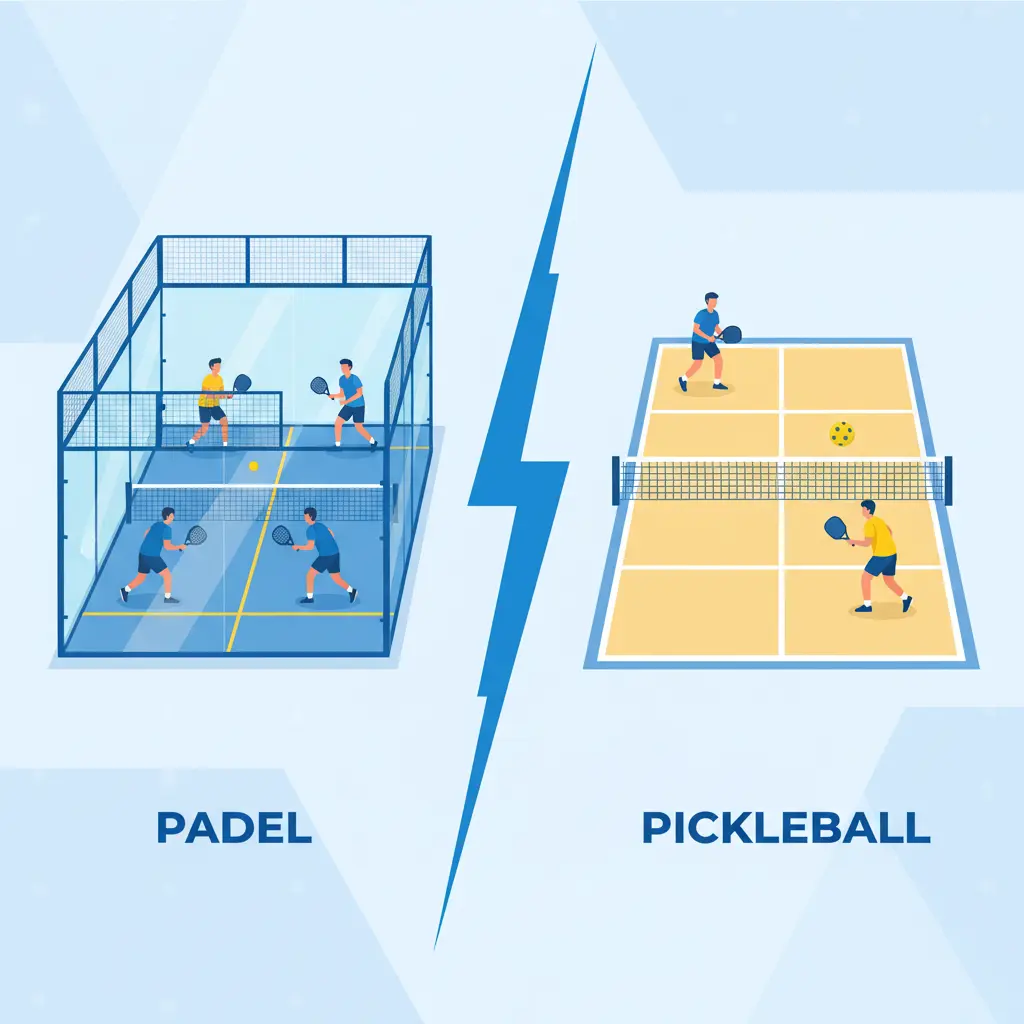
Padel court: 20 metres long and 10 metres wide, enclosed by glass walls at the back and sides and metal mesh higher up. The walls are in play with the ball allowed to bounce off the glass and be returned. Always played indoors or in an enclosed outdoor setting.
Pickleball court: 13.4 metres long and 6.1 metres wide. No walls with the court open like a tennis court. There is a non-volley zone called the kitchen extending 2.1 metres either side of the net where players cannot volley the ball.
The enclosed nature of padel and the open layout of pickleball create fundamentally different games despite their surface similarities.
What’s the Difference? The Racket
Padel racket: Solid, no strings, with a perforated foam core and a maximum length of 45.5cm. Comes in round, teardrop, and diamond shapes. Heavier than a pickleball paddle, typically 340-385g.
Pickleball paddle: Also solid with no strings but significantly lighter than a padel racket, 200-260g. Made from composite or graphite materials. Smaller face and shorter handle than a padel racket.
The lighter pickleball paddle makes the game feel faster and more wrist-driven. The heavier padel racket rewards technique and body rotation more.
What’s the Difference? The Ball
Padel ball: Pressurised rubber ball similar to a tennis ball but slightly smaller and at lower pressure. Bounces consistently on artificial grass surfaces.
Pickleball: A hard plastic ball with holes. Much lighter than a padel ball and behaves very differently, particularly in the wind. Indoor and outdoor pickleballs have different hole patterns.
The plastic pickleball makes a distinctive clicking sound and moves through the air more slowly than a padel ball, making the game feel more controlled at lower speeds.
What’s the Difference? The Serve
Padel serve: Underarm only, must bounce before being struck, struck below waist height, hit diagonally into the opponent’s service box. Two attempts permitted.
Pickleball serve: Also underarm, the ball must be struck below waist height. In the traditional serve the ball is dropped and struck without bouncing. There is also a drop serve where the ball is bounced first. Hit diagonally into the opponent’s service box.
Both sports use underarm serves, which is one reason both are regarded as more beginner-friendly than tennis.
What’s the Difference? The Kitchen Rule — Pickleball’s Defining Feature
Pickleball’s most distinctive rule is the non-volley zone, known as the kitchen. This is a 2.1 metre zone either side of the net where players cannot hit the ball before it bounces. Volleying in the kitchen is a fault.
This rule fundamentally shapes pickleball strategy because the battle to control the kitchen line without faulting is at the heart of the game. It slows the game down at the net compared to padel, where volleying anywhere on your side of the court is permitted.
Padel has no equivalent rule, players can volley anywhere on their side of the court at any time during open play.
What’s the Difference? Scoring
Padel scoring: Same as tennis — 15, 30, 40, game, set, match. First to six games wins the set. Best of three sets wins the match.
Pickleball scoring: Significantly different. Points can only be scored by the serving team — if the receiving team wins the rally they win the serve but not a point. Games are typically played to 11 points, win by two. Matches are best of three games.
Pickleball scoring takes some getting used to but produces a different tactical dynamic, holding serve becomes a key element of the game.
What’s the Difference? Singles vs Doubles
Padel: Almost exclusively doubles. The sport is designed for four players and the court size and wall play make singles rare and unconventional.
Pickleball: Played as both singles and doubles. Doubles is more popular but singles pickleball is a legitimate and widely played format with its own tactical character.
Padel vs Pickleball: Which is Easier to Learn?
Both sports are regarded as significantly easier to pick up than tennis — the underarm serve, smaller court, and solid racket all contribute to a faster initial learning curve.
Padel tends to produce enjoyable rallies very quickly as the enclosed court keeps the ball in play and the walls give you extra chances to retrieve shots. Most beginners are having fun within their first session.
Pickleball is arguably even simpler at the very start because the lighter paddle and slower ball make initial ball control very easy. However the kitchen rule adds a layer of tactical complexity that takes time to understand and apply correctly.
For most UK beginners coming to either sport fresh, padel offers the more immediately exciting and social experience. Pickleball is particularly well suited to older players or those who prefer a slower-paced, more tactical game.
Padel vs Pickleball: Which is More Popular in the UK?
Padel is significantly more established in the UK with hundreds of dedicated courts across the country and a rapidly growing club scene. Major investment from sports brands and investors has accelerated padel’s UK growth considerably.
Pickleball is growing fast in the UK but remains behind padel in terms of court availability and club infrastructure. It has a particularly strong following among older players and in leisure centre settings.
Both sports are growing — but if you’re looking for courts, coaching, and a social scene right now, padel has the bigger UK infrastructure.
Padel vs Pickleball: Can You Play Both?
Yes. The skills are complementary rather than conflicting. Wall reading from padel helps with court awareness in pickleball. The dink game in pickleball develops the soft touch that’s useful at the padel net.
Players with a background in either sport tend to pick up the other faster than complete beginners.
Frequently Asked Questions
Is padel or pickleball better for beginners?
Both are excellent for beginners. Padel tends to produce more exciting rallies immediately; pickleball has a simpler initial ruleset. Try both and see which you prefer.
Can you use a padel racket for pickleball?
No — the rackets are different shapes and weights. Pickleball paddles are specifically designed for the lighter plastic ball and the kitchen game. Using a padel racket for pickleball would be awkward and isn’t permitted in official play.
Is pickleball cheaper than padel?
Generally yes — pickleball court hire tends to be cheaper than padel, and paddles are less expensive than padel rackets. However padel’s quality of facilities in the UK is generally higher.
Which sport is better exercise?
Both provide excellent cardiovascular exercise. Padel tends to involve more lateral movement across a larger court; pickleball’s smaller court and slower ball can make it slightly less physically demanding at recreational level — which is part of its appeal for older players.
Are there professional leagues for both sports?
Yes — padel has the Premier Padel tour and pickleball has the Professional Pickleball Association (PPA) tour in the US. Both sports are growing their professional structures rapidly.
Interested in giving padel a go? Check out our guides to the best padel rackets for beginners, best padel shoes for men, and how to play padel to get started.