Padel vs Tennis. What’s the difference? They are very similar, with players crossing over regularly, but also different enough that each sport has its own distinct identity, tactics, and appeal. If you’re trying to decide between the two, or you’re a tennis player curious about padel, this guide breaks down exactly how the two sports compare.
The Court
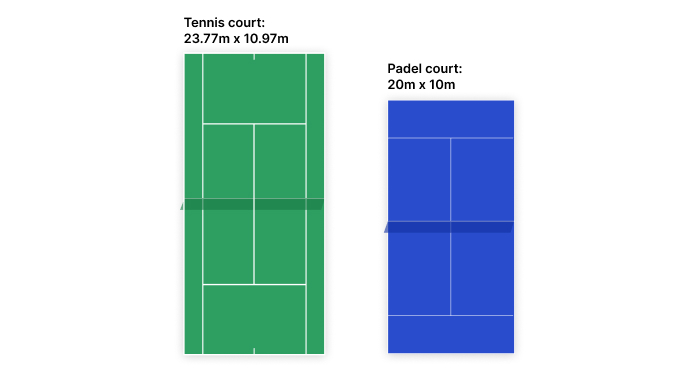
The most obvious difference between padel and tennis is the court itself.
A tennis court measures 23.77 metres long and 8.23 metres wide for singles, significantly larger than a padel court which measures 20 metres long and 10 metres wide. More importantly, a padel court is fully enclosed by glass walls and metal mesh, with those walls being in play. The ball can bounce off the glass and still be returned, adding a dimension of play that simply doesn’t exist in tennis.
Tennis courts, however come in multiple surfaces, including grass, clay, and hard court, while padel courts are almost exclusively artificial grass with a sand infill, meaning the surface experience is consistent wherever you play.
The Racket
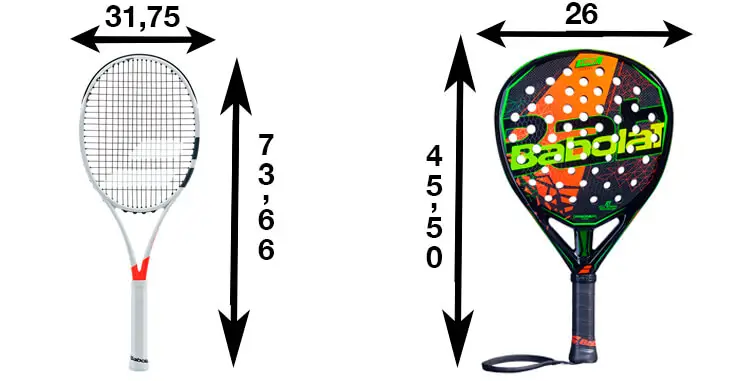
Tennis rackets are strung with nylon or natural gut strings and come in a wide variety of head sizes and weights. Padel rackets are completely solid — no strings — with a perforated face and a foam core. They’re also significantly shorter, with a maximum length of 45.5cm compared to tennis rackets which can reach 73.7cm.
The result is a very different feel. Tennis rewards technique and swing speed. Padel is more about touch, placement, and reading the walls. Many players find padel rackets easier to control immediately, which contributes to the sport’s reputation as beginner-friendly.
The Serve
In tennis, the serve is one of the most technical and powerful shots in the game, where it’s hit overhead from a standing position with significant pace and spin. In padel, the serve is underarm only. The server must bounce the ball and strike it at or below waist height, diagonally into the opposite service box.
This single rule change fundamentally alters the dynamic of the game. In tennis, a powerful serve can win points outright. In padel, the serve is simply a way to start the rally with the real game begins after that.
Singles vs Doubles
Tennis is regularly played as both singles and doubles. Padel is almost exclusively doubles — four players on court at all times. This makes padel an inherently more social sport, which is a big part of why it has grown so rapidly. You need four people to play a proper game, which means padel clubs tend to have a strong community feel that tennis clubs sometimes lack. However you can also play single padel, with the courts being smaller and the same rules still applying to that of doubles.
The Walls
This is the defining feature of padel. In tennis, if the ball goes out, the point is over. In padel, the ball can bounce on your side of the court and then hit the glass wall, and you can still play it. You can also deliberately hit the ball into the opponent’s glass wall after it bounces on their side, a tactic used constantly at higher levels.
Learning to read the ball off the walls is what gives padel its unique tactical depth. Shots that look like they’re going out can come back into play at unexpected angles, and the best padel players use the walls creatively to win points.
Scoring
Both sports use the same scoring system: 15, 30, 40, game, set, match. A key difference is that padel matches are almost always best of three sets, while professional tennis can go to five. For casual and club play, the formats are essentially the same.
How Hard is Each Sport to Learn?
What is the difference? Tennis has a steeper learning curve. The serve alone takes significant practice to make consistent, and the larger court and longer racket demand more precise technique from the start.
Padel is widely regarded as easier to pick up. The underarm serve is immediately manageable, the enclosed court keeps more balls in play, and rallies develop quickly even between beginners. Most people can have a genuinely enjoyable game of padel within their first session.
Padel vs Tennis: What’s the difference? Which Sport is Right for You?
Choose tennis if: You prefer a sport with a rich individual tradition, enjoy playing singles, or want a sport you can play outdoors on a variety of surfaces.
Choose padel if: You want something social and doubles-focused, you’re looking for a sport that’s quick to pick up, or you want something that combines the elements of tennis and squash into something genuinely new.
For most people, padel and tennis complement each other well. Many tennis players find padel makes them better at net play and reading spin, while padel players who pick up tennis develop stronger groundstroke technique.
Padel vs Tennis: What’s the difference? Frequently Asked Questions
Can tennis players pick up padel easily?
Yes — the scoring, general racket skills, and court awareness transfer well. The main adjustments are the underarm serve, playing off the walls, and adapting to the smaller court dimensions.
Is padel easier than tennis?
For most beginners, yes. The serve is simpler, rallies develop faster, and the enclosed court means fewer balls go out of play. The tactical depth comes later as you improve.
Can I use a tennis racket for padel?
No — padel rackets are solid with no strings. Tennis rackets are not permitted in padel.
Is padel more popular than tennis?
Globally, tennis remains far more popular. But padel is the fastest growing racket sport in the world and is closing the gap rapidly, particularly in Spain, Argentina, and increasingly the UK.
Do padel and tennis use the same balls?
No — padel balls are slightly smaller and pressurised to a lower level than tennis balls. They look similar but aren’t interchangeable for serious play.
Thinking about giving padel a go? Check out our guides to the best padel rackets for beginners, best padel shoes for men, and best padel balls to get properly equipped.